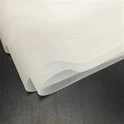
Both are called EVA, one for shoe soles and the other for laminated glass. Same name, but a completely different product. For many, "it's just a layer of plastic," simply shoving ordinary EVA into the middle of glass-the result is a fogged, layered glass that turns yellow after three months. What is the problem? That's because you didn't understand the difference between the two films.
Essentially different: One is a generic material, the other a special recipe. Ordinary EVA is short for ethylene-vinyl acetate copolymer, widely used in foamed shoe materials, packaging films, hot melt glue, cable, toys and other fields. The slippers you wear are made of it, as are the cushioning membranes in the delivery bags. Its core requirements are softness, low price, convenient processing, no strict requirements for light transmittance, adhesion strength, weather resistance.
The EVA film used in laminated glass, while chemically similar, have a deeply modified formula specifically designed to "bind permanently to glass." It must also meet three strict performance indicators: optical-grade transparency, high adhesion strength to glass, long-term moisture and heat resistance without decolletage. Even without them, it's not a a laminated film, it's flawed.
Performance Gap: Data doesn't lie
For example, for a 0.38mm thick transparent laminated film, the core performance indicators specified by national standard GB9962-99 were as follows: tensile strength ≥17MPa, fracture elongation ≥ 650%, visible light transmittance ≥87%, haze rate ≥ 0.6%, adhesion strength ≥2kg/cm, water absorption rate ≤0.15%, and UV cutoff rate of 98.5%.
What does a regular EVA films meet? Hardly. Ordinary materials typically have a a light transmittance of just over 80%, a high haze rate and a wide range of adhesion strength-if you try to bind laminated sandwich glass a shoe material EVA, the bond simply won't withstand the impact. Once the glass breaks, the film and glass separate directly, resulting in zero safety.
More importantly, it's water resistance. EVA absorbs less than 0.15% of water in laminated glass, compared to much higher rates in ordinary EVA. Once it absorbs moisture, its bond strength plummets. That's why many laminated glass products blister and decolletage after a few months-not because of manufacturing defect, but because the wrong film was chosen.
The processing logic is completely different. Ordinary EVA processing, involving extrusion, film blowing and rolling, is done on the assembly line before production begins. However, EVA used in laminated glass requires additional stringent quality control steps from raw materials to finished product-moisture, dust and pollution protection. Once unwrapped, the film cannot be exposed to air, and slit films must be used on the same day, otherwise it must be sealed and stored. This is because EVA film have a extremely strong adsorption capacity, dust will reduce light transmittance, moisture absorption will lead to a decrease in adhesion.
In terms of processing temperature, the compound EVA has good fluidity and adhesion at around 110 ℃. The layering can be completed by simple vacuum heating with a total investment of about $100,000 in equipment. By contrast, PVB requires autoclaves at 120 to130°C, pressure 1.0 to1.3MPa, and insulation for 30 to60 minutes, and equipment is invested in the millions. This is why EVA laminated glass is cost-effective-cheap film, cheap equipment and simple technology.
Cheap, however, does not mean careless. EVA film has excellent fluidity and can be embedded in wires and rolls to form decorative glass with rich patterns, something PVB cannot do. Thus, EVA laminate glass is essentially a competitor in the decorative field-interior partitions, art glass and wire glass; its stage is indoors, not outdoors.
Biggest trap: Ultraviolet radiation. This is the common disadvantage of splint EVA and ordinary EVA, and the fundamental reason it can only be used indoors. EVA is far less UV resistant than PVB and SGP. PVB film a yellowing coefficient of between 6 and 12, SGP is less than 1.5, and EVA turns yellow and black in prolonged sunlight. As a result, the EVA laminated glass you see is used almost exclusively for interior partitions and decorations, and rarely for exterior curtain walls.
Regular EVA for soles can be yellow, which is fine because it's underfoot. But when sandwiched between glass panels, yellowing is a disaster-reducing light transmittance, ruining aesthetics and affecting customer returns.
In short, regular EVA is a cheap all-purpose material that does a few things, but isn't an expert on any of them. laminated glass EVA is a special kind of high performance material: high light transmittance, strong adhesion, low water absorption and resistance to humidity and heat, but vulnerable to sunlight, dirt and light. Choosing the right movie can produce million-dollar results with a 100,000-dollar setup; choosing the wrong movie can render even million-dollar settings useless. Stop making glass out of soles, it's not about saving money, it's about creating disaster.
Jun 01, 2026
What Is The Difference Between An EVA Film For Laminated Glass And A Ordinary EVA Film? Don't Laminate With Soles!
Previous
No Information
Next
Send Inquiry