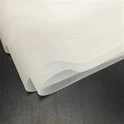
PE (polyethylene) sheet is a widely used plastic material. Due to its excellent physical properties, chemical stability and processing performance, it plays an important role in packaging, construction, agriculture, electronics and electrical appliances and other fields. Among them, extrusion molding is one of the most important methods for producing high-quality and high-performance sheets. However, PE sheets often encounter fluidity problems during the manufacturing process, which not only reduces the efficiency of production, but also may lead to reduced product quality, such as surface defects and dimensional instability. Because the flow direction of the polymer melt is opposite to the tangential direction during extrusion molding, the tensile stress decreases as the shear rate increases, causing the product to have quality defects such as wrinkles and cracks. Therefore, studying and optimizing the flow characteristics of PE sheets is crucial to improving production efficiency and the quality of the final product.
What is the main reason for the poor fluidity of PE sheet materials?
The flow characteristics of PE sheets are mainly determined by their inherent properties. Different types of polyethylene sheets require the use of a variety of additives during processing to achieve the required performance. The core elements that determine fluidity are the distribution of molecular weight and the structure of the molecule. High molecular weight PE sheets usually show higher melt viscosity, which leads to relatively poor fluidity. In processing, if appropriate process conditions are adopted, its fluidity can be significantly improved, thereby improving the quality and output of products. In addition, the type and content of additives have a significant effect on its fluidity. Therefore, it is very important to select suitable additives and rationally design the formula to improve the fluidity of products. For example, excessive fillers or certain types of antioxidants may cause the viscosity of the melt to increase, thereby affecting its fluidity. In addition, processing parameters such as stretching rate and shear rate also play an important role in its fluidity, and temperature is one of the main factors affecting the flow behavior of polymers. At the same time, we cannot ignore the storage conditions and time. Long-term high-temperature storage may cause aging of the material, thereby affecting its fluidity.
How does processing temperature affect the fluidity of PE sheet materials?
The fluidity of PE sheets is significantly affected by the key factor of processing temperature. As the temperature gradually rises, the PE sheet begins to melt gradually, the viscosity of its melt decreases, and the fluidity is enhanced. When the temperature exceeds a certain limit, the melt viscosity drops sharply, the flow resistance increases, and the quality of the product is seriously reduced. However, too high a temperature may cause the degradation of the material and generate small molecular compounds, which in turn will increase the viscosity of the melt and reduce its fluidity. In the actual production process, in order to obtain better mechanical properties and higher heat resistance, it is often necessary to select a relatively reasonable processing temperature range. Therefore, it is particularly important to clarify the most suitable processing temperature range. This paper takes polyethylene as the research object, tests the rheological properties and mechanical properties of samples extruded at different temperatures, and uses finite element software to establish a model for simulation analysis. After experimental research and simulation analysis, we can determine an ideal temperature position that can both enhance fluidity and prevent degradation.
How to improve the fluidity of PE sheets by adjusting the formula?
In order to improve the fluidity of PE sheets, adjusting its formula is an effective strategy. The main factors affecting the rheological properties of polymers include molecular weight distribution and molecular chain structure, crystal morphology and its arrangement. By adding a variety of additives such as plasticizers, lubricants and nucleating agents, the viscosity of the melt can be effectively reduced and its fluidity can be enhanced. In addition, additives can also increase the cross-linking effect between polymer molecular chains, thereby further improving the mechanical properties of the material. However, in order to avoid adverse effects on other properties of the material, the type and content of additives need to be strictly controlled. For example, excessive plasticizers may reduce the strength of the material, while too much lubricant may affect the surface finish of the material. In addition, when the additive dosage is too high, it will also cause processing difficulties or even product failure. Therefore, when optimizing the formula design, it is necessary to find a balance between fluidity and other properties.
How do mold design and process parameters affect the fluidity of PE sheets?
The fluidity of PE sheets is greatly affected by mold design and process parameters. By analyzing and studying the characteristics of different types of materials and the changes in flow channel shape and size during the molding process, the mold cavity structure design principles and methods suitable for processing various different material products are obtained. By carefully designing the structure of the mold, such as the layout of the flow channel and the design of the gate, it can be ensured that the molten material can flow evenly in the mold, thereby avoiding the unsmooth flow caused by local overheating or uneven cooling. In addition, process parameters such as injection speed, pressure and duration have a regulating effect on fluidity. This paper uses the orthogonal test method to study the influence of the above factors on the fluidity of the sheet, and uses the regression analysis method to establish the relationship equation between each factor and the plasticization rate. By optimizing and adjusting these parameters, we may be able to further enhance the flow characteristics of PE sheets.
What specific methods and techniques can be used in practice to improve the fluidity of PE sheets?
In actual operation, there are many different methods and techniques to improve the fluidity of PE sheets. Currently, additives are added to polymers to increase their viscosity and rheological properties. Advanced manufacturing technologies, such as gas-assisted injection molding and co-injection molding, can enhance the fluidity of the melt by changing its flow path and shape. By implementing a series of measures to optimize the processing flow, such as preheating and temperature control, the viscosity of the melt can be significantly reduced and its fluidity can be enhanced. In addition, the mold needs to be cooled or heated during extrusion to maintain a constant temperature, which helps to maintain the shape and dimensional accuracy of the product, thereby ensuring product quality. In addition, quality control is also crucial. In the actual production process, raw materials are usually inspected and tested. By checking the quality of raw materials, we can ensure that the PE sheets used meet the quality standards. At the same time, process monitoring can quickly identify and deal with problems that arise during processing. By studying the polyethylene sheets produced by a certain company, a set of effective production processes was summarized to achieve the purpose of improving product quality and reducing production costs. Sharing successful cases and practical experience provides valuable guidance for improving the fluidity of PE sheets.
In summary, there are various strategies and practical methods to improve the fluidity of PE sheet materials, including optimizing material selection, adjusting processing temperature, optimizing formula design, improving mold design and process parameters, and adopting advanced molding technology. The implementation of these measures can not only improve the fluidity of PE sheets, but also improve product quality and production efficiency. In the future, with the development and application of new additives and the continuous advancement of processing technology, we have reason to believe that the fluidity problem of PE sheets will be more effectively solved. At the same time, continuous research and innovation will also provide strong support for the application of PE sheets in more fields.